PosterBloom art literacy
Art terms, without the category confusion
Plain-language definitions for art movements, visual techniques, composition, color, interiors, and print production—with clear distinctions between an image’s influence and how a print is physically made. Use this glossary to identify what you see, place historical language in context, and understand exactly what a PosterBloom product description does—and does not—claim.
Three layers of art terminology
01
Historical context
Modernism, Bauhaus, and Brutalism refer to real histories—not interchangeable decor aesthetics.
02
Visible language
Composition, geometry, marks, and color describe evidence you can read in the image itself.
03
Physical production
The shipped object is a giclée print even when its image evokes linocut, lithograph, or screenprint.
Read a listing in the right order
Start with the physical product specification. Then read a visual-technique or style label as interpretation of the image. Finally, use the linked guide and institutional source to place that resemblance in a wider history. This order prevents an image that looks carved, layered, or brushed from being mistaken for an original analog print or painting.
Our language standard
“Influenced by” describes a visible relationship. It never implies attribution, reproduction, affiliation, endorsement, or authorship by a historical artist, school, estate, or museum. Likewise, “linocut-influenced” describes the image—not the giclée process used to make the PosterBloom print.
Browse by term
- Color and interiorsAnalogous colors
Colors that sit next to one another on a color wheel, such as blue, blue-green, and green. They usually share enough hue to create continuity while still allowing visible variation.
Institutional context: National Gallery of Art, The Elements of Art: ColorIn PosterBloom language: In a room, an analogous palette can connect art and furnishings without requiring exact color matches.
- Historic movement or schoolBauhaus
A German school of art, craft, design, and architecture founded in Weimar in 1919, later based in Dessau and Berlin, and closed in 1933. Its teaching changed across directors and joined studies of form and color with workshop practice.
Institutional context: Bauhaus Dessau Foundation, Bauhaus chronologyIn PosterBloom language: Bauhaus is a specific historical institution—not a synonym for every geometric poster or primary-color composition.
- Visual languageBiomorphic
Describes abstract forms that suggest living organisms, bodies, cells, plants, or natural growth without necessarily depicting any one of them literally.
Institutional context: Museum of Modern Art, BiomorphicIn PosterBloom language: Biomorphic is a description of form. It does not make a contemporary work part of a single historic movement.
- Historic movement or schoolBrutalism
A mid-twentieth-century architectural approach associated with formal clarity, exposed structure, raw materials, and often monumental mass. It developed in postwar contexts and is broader than concrete alone.
Institutional context: Museum of Modern Art, Brutalist ArchitectureIn PosterBloom language: For wall art, ‘Brutalist-influenced’ identifies visual qualities borrowed from architecture; it does not turn a print into a historical Brutalist building or object.
- Artmaking techniqueCollage
A technique that constructs an image by attaching pieces of paper or other materials to a support. Cut edges, seams, overlaps, and abrupt changes of scale can remain visible in the finished work.
Institutional context: Museum of Modern Art, CollageIn PosterBloom language: A giclée print may reproduce or evoke a collage-like image without containing physically attached paper layers.
- Color and interiorsColor temperature
The relative impression that one color is warmer or cooler than another. A blue can look warm beside a greener blue, and a red can look cool beside orange.
Institutional context: Josef and Anni Albers Foundation, Interaction of ColorIn PosterBloom language: Temperature is relational, so judge an artwork beside the room’s actual light and materials rather than by a fixed list of warm and cool hues.
- Color and interiorsComplementary colors
Pairs positioned opposite one another on a traditional color wheel, such as blue and orange. Their contrast can sharpen edges and emphasis when the colors appear together.
Institutional context: National Gallery of Art, The Elements of Art: ColorIn PosterBloom language: The effect also depends on value, saturation, area, and surrounding colors; complementary does not automatically mean loud.
- Visual languageComposition
The arrangement and relationship of visual elements within an artwork: where forms sit, how large they are, where the eye moves, and how filled and empty areas balance.
Institutional context: J. Paul Getty Museum, Understanding Formal AnalysisIn PosterBloom language: Composition describes what the picture does structurally before a viewer assigns a style label or mood word.
- Visual languageFocal point
An area that attracts attention first or carries unusual visual emphasis through contrast, placement, scale, detail, or isolation.
Institutional context: J. Paul Getty Museum, Understanding Formal AnalysisIn PosterBloom language: Not every composition has one dominant focal point; some deliberately distribute attention across a field or repeated system.
- Visual languageGeometric abstraction
Nonrepresentational art organized through geometric shapes, lines, grids, intervals, or mathematical relationships. Its histories include distinct movements and artists with different aims.
Institutional context: The Metropolitan Museum of Art, Geometric AbstractionIn PosterBloom language: ‘Geometric’ describes a broad visual language; it should not flatten Suprematism, De Stijl, Bauhaus teaching, and later abstraction into one movement.
- Print productionGiclée print
A fine-art inkjet print made by depositing very small droplets of ink onto paper or another surface. The term identifies the printing method, not the technique depicted in the image.
Institutional context: Smithsonian National Museum of African Art, Insights glossaryIn PosterBloom language: PosterBloom’s physical products are giclée prints, including images that visually evoke linocut, lithograph, watercolor, collage, or screenprint.
- Artmaking techniqueGouache
An opaque water-based paint that can create flat, dense color as well as visible brush texture. Unlike transparent watercolor washes, the paper beneath is often obscured.
Institutional context: Museum of Modern Art, GouacheIn PosterBloom language: ‘Gouache-influenced’ describes an image’s opaque-looking color and surface; it does not claim the shipped giclée print is an original gouache painting.
- Color and interiorsHue
The basic family of a color—such as red, yellow, green, or blue—before describing how light, dark, vivid, or muted it is.
Institutional context: National Gallery of Art, The Elements of Art: ColorIn PosterBloom language: Hue alone is not enough to match art to a room; compare value, saturation, undertone, proportion, and lighting too.
- Visual languageInfluenced by
Editorial language indicating that a contemporary work draws from recognizable historical ideas, formal strategies, or material effects without claiming to be a historical object.
Institutional context: Museum of Modern Art, What is modern art?In PosterBloom language: At PosterBloom, the phrase does not imply attribution, reproduction, affiliation, endorsement, or authorship by an artist, school, estate, or museum.
- Artmaking techniqueInk
A fluid coloring material used for drawn lines, washes, printing, writing, and many other processes. Its visual behavior depends on formulation, tool, pressure, dilution, and support.
Institutional context: Museum of Modern Art, InkIn PosterBloom language: An ink-like edge or wash in a digital image is a visual influence; it does not identify the method used to manufacture the physical print.
- Artmaking techniqueLinocut
A relief-printing process in which the artist cuts away areas of linoleum, inks the raised surface, and transfers that image to paper. Cut channels remain unprinted.
Institutional context: National Gallery of Art, Printmaking BasicsIn PosterBloom language: PosterBloom uses ‘linocut-influenced’ for carved-looking edges and relief-like marks; the shipped work is a giclée print, not a block-pulled linocut.
- Artmaking techniqueLithograph
A planographic print made from a drawn image on a prepared stone or plate, using the resistance between grease and water rather than carving the printing surface.
Institutional context: The Metropolitan Museum of Art, LithographIn PosterBloom language: A giclée image can evoke lithographic crayon or tonal drawing without being physically printed from a lithographic stone or plate.
- Visual languageMark-making
The visible traces that build an image: lines, strokes, cuts, dots, smears, washes, repeated impressions, and edges. Marks can reveal rhythm, pressure, direction, or simulated material behavior.
Institutional context: J. Paul Getty Museum, Understanding Formal AnalysisIn PosterBloom language: Describe the mark you can see before inferring a tool or process the available evidence cannot prove.
- Historic movement or schoolModernism
A broad and contested set of artistic and cultural experiments associated mainly with the late nineteenth and twentieth centuries, when artists challenged inherited subjects, institutions, and ways of making.
Institutional context: Museum of Modern Art, What is modern art?In PosterBloom language: Modernism is not one clean geometric look. ‘Modernist-influenced’ should name a specific visual strategy rather than use history as a decor shortcut.
- Artmaking techniqueMonotype
A print made by transferring an image painted or drawn on a smooth plate, generally producing one primary impression rather than a repeatable edition of near-identical impressions.
Institutional context: Museum of Modern Art, MonotypeIn PosterBloom language: Monotype-like variation, wiping, or transferred texture can be pictured in a giclée print without making the product an original monotype.
- Visual languageNegative space
The unoccupied or comparatively quiet area around and between depicted forms. It can separate, frame, compress, balance, or direct attention just as actively as a filled shape.
Institutional context: J. Paul Getty Museum, Understanding Formal AnalysisIn PosterBloom language: Negative space is not leftover background; read its shape and proportion as part of the composition.
- Visual languageOrganic modern
A contemporary interiors and merchandising label combining modernist restraint or structure with natural materials, warm neutrals, irregular contours, and biomorphic form.
Institutional context: Museum of Modern Art, Organic Design in Home FurnishingsIn PosterBloom language: Organic modern is not a single historic art movement. Use it to describe a present-day room or curation logic, then name the specific historical influence separately.
- Artmaking techniqueRelief printing
A family of processes in which ink sits on the raised parts of a block or plate while cut-away areas usually remain unprinted. Woodcut and linocut are common examples.
Institutional context: Victoria and Albert Museum, What is print?In PosterBloom language: Relief-print influence can describe bold silhouettes and carved-looking gaps, but physical process claims require an actually inked and impressed block.
- Visual languageRhythm
A sense of visual movement produced by repetition, interval, alternation, or gradual change among shapes, marks, colors, or spaces.
Institutional context: J. Paul Getty Museum, Understanding Formal AnalysisIn PosterBloom language: Rhythm can be regular, syncopated, accelerating, or interrupted; repetition alone does not guarantee that it feels active.
- Artmaking techniqueRisograph
A stencil-duplicator printing process that uses ink drums and automatically made masters to lay down spot colors. Two-drum machines can print two colors together; layering can produce overprints, halftones, limited palettes, and small registration shifts.
Institutional context: RISO, RISO MH SeriesIn PosterBloom language: ‘Risograph-influenced’ describes those visible color-layer effects; PosterBloom’s physical prints are giclée, not output from a RISO duplicator.
- Color and interiorsRoom palette
The working group of colors created by a room’s fixed materials, furnishings, textiles, objects, artwork, and changing light—not merely its wall-paint swatches.
Institutional context: Josef and Anni Albers Foundation, Interaction of ColorIn PosterBloom language: Choose whether art should repeat, bridge, or deliberately challenge this palette instead of matching every hue exactly.
- Color and interiorsSaturation
The intensity or purity of a color relative to a grayer, duller version of the same hue. High-saturation color appears vivid; lower saturation appears muted.
Institutional context: National Gallery of Art, The Elements of Art: ColorIn PosterBloom language: Saturation works with value and area: a small vivid accent can dominate a much larger muted field.
- Artmaking techniqueScreenprint
A print made by forcing ink through open areas of a prepared mesh screen while blocked areas prevent ink from reaching the surface. Separate screens can build layered colors.
Institutional context: Museum of Modern Art, SilkscreenIn PosterBloom language: Flat color and overprint can be screenprint-influenced; they do not prove that the physical product was pulled through screens.
- Color and interiorsUndertone
The subtle warm, cool, green, violet, red, or yellow bias perceived within a neutral or low-saturation color when it is compared with its surroundings.
Institutional context: Josef and Anni Albers Foundation, Interaction of ColorIn PosterBloom language: Undertone is contextual rather than a hidden pigment label; compare samples beside the room’s wood, stone, textiles, and actual light.
- Color and interiorsValue
The relative lightness or darkness of a color or tone. Value contrast often determines legibility and visual hierarchy before hue differences do.
Institutional context: National Gallery of Art, The Elements of Art: ColorIn PosterBloom language: Squint at an artwork or view it in grayscale to test whether its light-dark structure supports the room effect you want.
- Visual languageVisual hierarchy
The order in which elements attract attention, created through differences in scale, contrast, placement, isolation, detail, or repetition.
Institutional context: J. Paul Getty Museum, Understanding Formal AnalysisIn PosterBloom language: A strong hierarchy can lead from one dominant form to secondary details, while some works intentionally resist a single reading order.
- Print productionVisual-technique label
PosterBloom’s editorial description for the process an image visually evokes—such as linocut, lithograph, screenprint, or watercolor—when that process is not the method used to manufacture the physical print.
Institutional context: Victoria and Albert Museum, What is print?In PosterBloom language: Read the label as ‘looks influenced by,’ then read the product specification for the actual production method. PosterBloom products are giclée prints unless a product page explicitly says otherwise.
- Artmaking techniqueWatercolor
A water-based painting medium commonly used in transparent washes that allow the paper and earlier layers to remain visible. Water, pigment load, paper, and handling affect blooms, edges, and granulation.
Institutional context: Victoria and Albert Museum, What is watercolour?In PosterBloom language: A watercolor-influenced image can reproduce transparent-looking washes, while the shipped giclée print remains ink on fine-art paper.
- Artmaking techniqueWoodcut
A relief print made from an inked woodblock whose nonprinting areas have been cut away. Grain, gouge direction, pressure, and the meeting of black and unprinted paper can shape its marks.
Institutional context: The Metropolitan Museum of Art, WoodcutIn PosterBloom language: Woodcut-influenced imagery may simulate these cues, but a giclée product is not an impression pulled from a carved woodblock.
Practice on a real work
Separate what the image looks like from what the product is
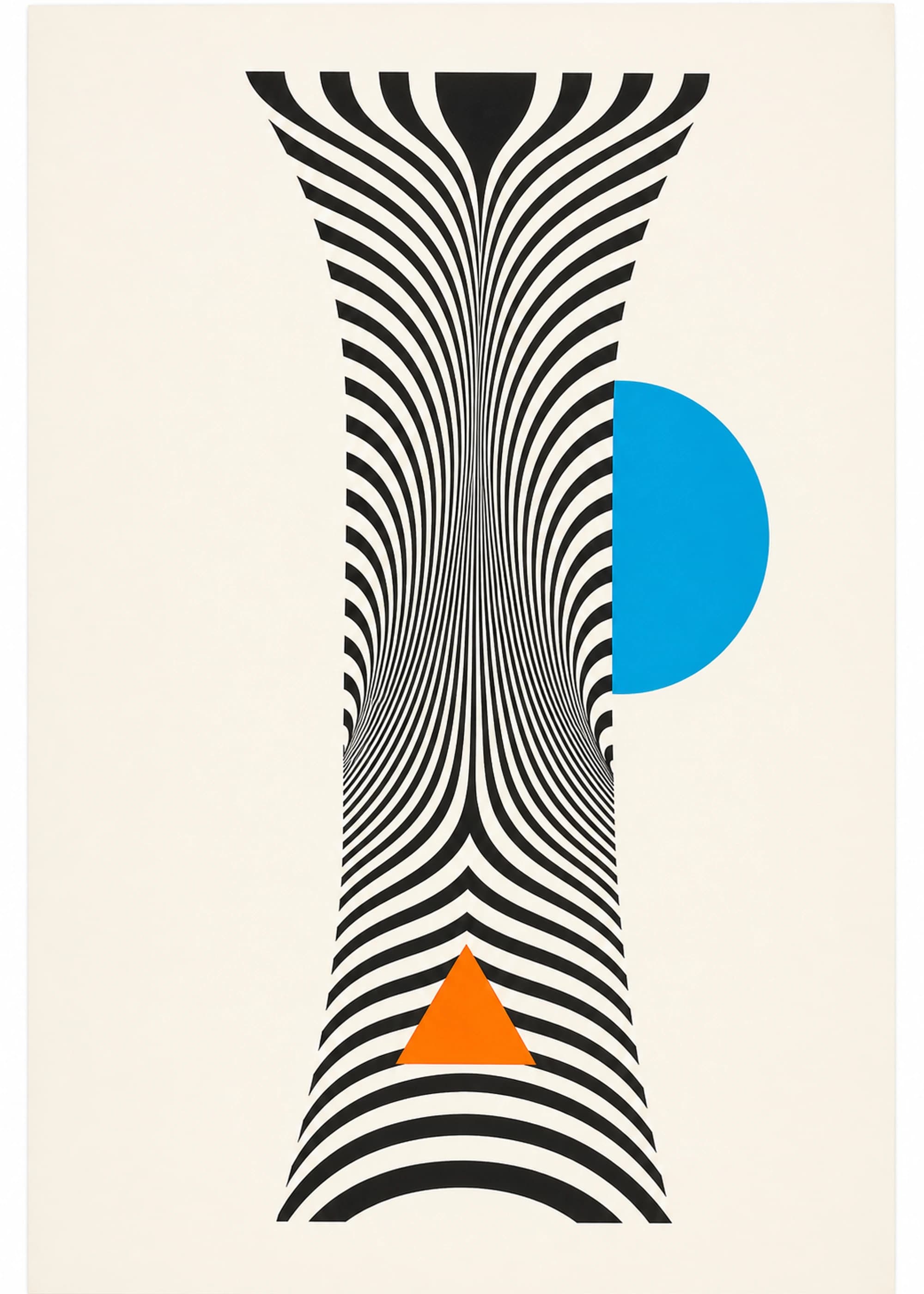
PosterBloom example: use the glossary to distinguish geometric visual language, composition, and the physical giclée print process.
View the print and its production factsGo from vocabulary to looking
A definition is only a starting point. Practice by identifying a composition’s focal structure, marks, edges, color relationships, and negative space before deciding which history it resembles or how it might work in a room.