Framing & care guide
Mat vs no mat for art prints
A mat adds visual breathing room and separates art from glazing; no mat gives a tighter, more graphic presentation. PosterBloom's current framed variants ship without a mat or mount.
PosterBloom guide · 7 min read · Updated Jul 14, 2026
The useful version
Choose a mat when you want more breathing room, a larger overall framed footprint, or separation between the image and frame. Skip it when you want the printed area to feel larger and more immediate. Current PosterBloom framed variants ship without a mat unless the selected product variant explicitly says otherwise.
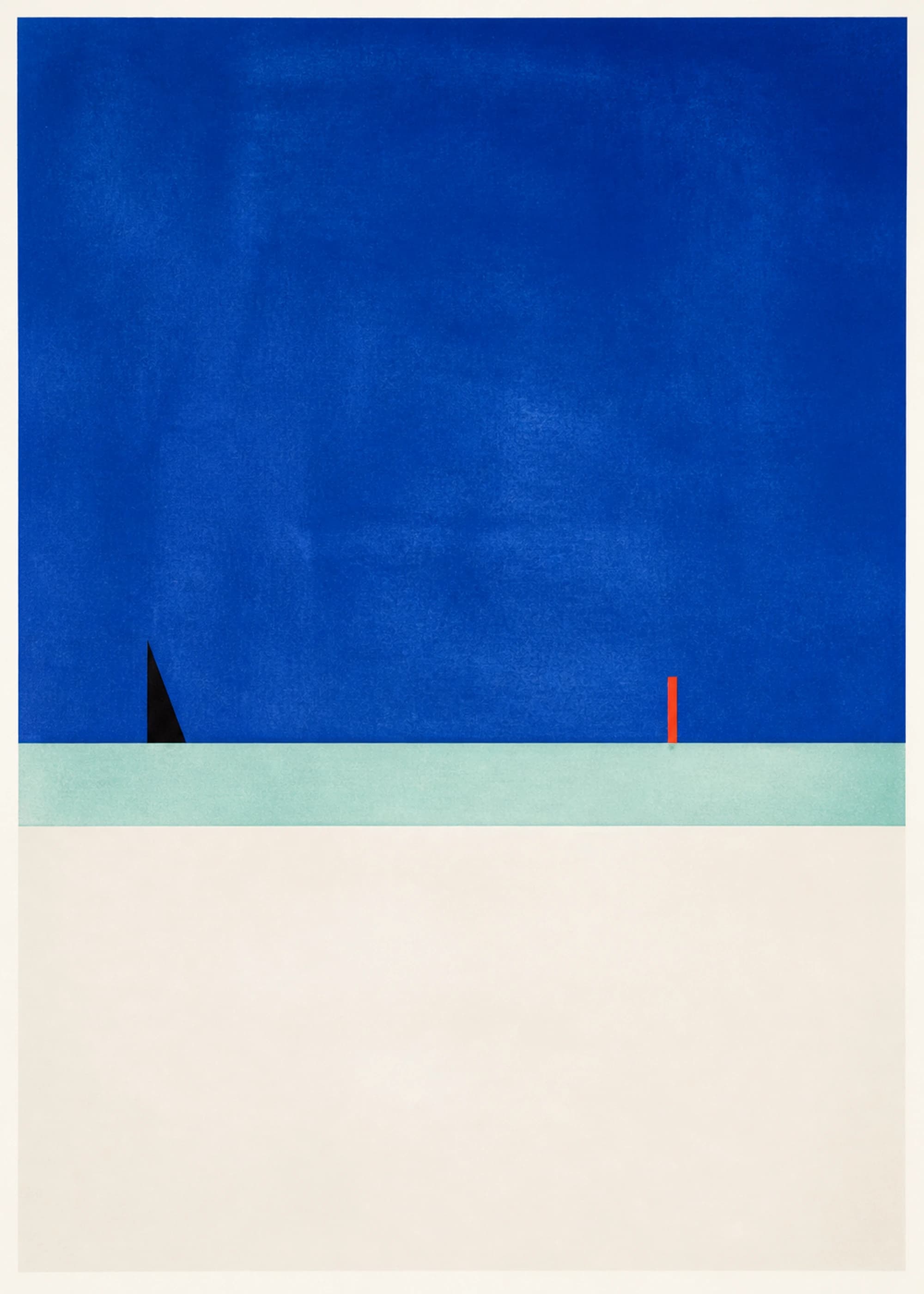
The mat is a visual decision before it is anything else
A mat is the border placed between the visible print and the frame. It changes proportion, contrast, and the amount of quiet space around the image. It also increases the outside dimensions of the finished piece, so a 50 × 70 cm print does not remain a 50 × 70 cm object after a mat and frame are added.
No mat keeps the presentation compact. The artwork occupies more of the frame opening, which can suit bold geometry, dense color, or a wall where the available width is already tight. Neither treatment is inherently more serious, more expensive-looking, or more appropriate for every print.
Use a mat when the artwork needs separation
- The image and frame compete. A light border can prevent a strong black frame from visually closing over delicate marks, pale washes, or generous negative space.
- The print needs more wall presence. A mat can enlarge the overall framed footprint without enlarging the printed image. Measure that final footprint before ordering neighboring pieces or drilling hardware.
- Several prints need one visual system. Consistent mat widths can organize a set with different colors or compositions. Consistency matters more than choosing the widest possible border.
Skip the mat when scale and immediacy matter more
No-mat framing works well when a composition already contains a strong internal border, when color or marks should reach close to the frame, or when the wall cannot accommodate the extra width. It can also make a small print read as a concentrated object rather than a small image floating inside a large surround.
Do not confuse “no mat” with unframed. PosterBloom's active PDPs separate the unframed print from natural and black framed variants. The framed choices use solid satin-laminated wood and Perspex glazing; the active frame label does not include a mat.
Natural or black: choose by contrast, not a preservation promise
Natural oak-effect
Useful when the room already has pale wood, linen, warm neutrals, or softer contrast. It can extend the paper's warmth without disappearing against every wall.
Black satin
Useful when the composition needs a firm edge or the room has black metal, dark joinery, or higher contrast. It can overpower pale work if the image has little visual weight near its edge.
These are visual relationships, not universal rules. A frame finish alone does not establish light protection, conservation performance, or longevity. PosterBloom's standard glazing is listed as Perspex; we do not represent it as UV-filtering.
What PosterBloom sells now—and what requires a local framer
Current PosterBloom product pages offer the active combinations for that work: unframed, natural wood-effect framed, or black framed in the sizes shown. Those framed products ship without a mat unless the variant label explicitly changes in the future. If a configuration is not listed on the product page, it is not a current store option.
If you want a mat today, choose an unframed print and discuss the opening, border width, frame depth, glazing, backing, and hanging hardware with a qualified local framer. Ask the framer to describe the exact materials supplied rather than relying on broad words such as “archival” or “museum.”
Before deciding, open a real PDP such as Quiet Load Bearing and compare the live size and frame variants. Then use the wall-art size calculator to choose a nominal print arrangement from the active catalog. Obtain the finished outside dimensions from the selected frame or local framer before checking wall clearance and neighboring gaps.
A fast decision checklist
- 1. Read the edge. Does the image need a pause before the frame, or does it benefit from reaching the edge?
- 2. Measure the whole object. Add the mat and frame to the print size before judging furniture proportion, neighboring gaps, and wall clearance.
- 3. Check the live variant. Confirm the selected product's actual size, frame, price, and availability on its PDP.
- 4. Separate appearance from care. Choose placement, glazing, backing, and handling from their stated specifications—not from the frame color or presence of a mat.
Keep exploring
Sources and further reading
Framing and care guidance in this guide is grounded in the manufacturer, museum, and conservation sources below. PosterBloom product details describe our current active catalog configuration.